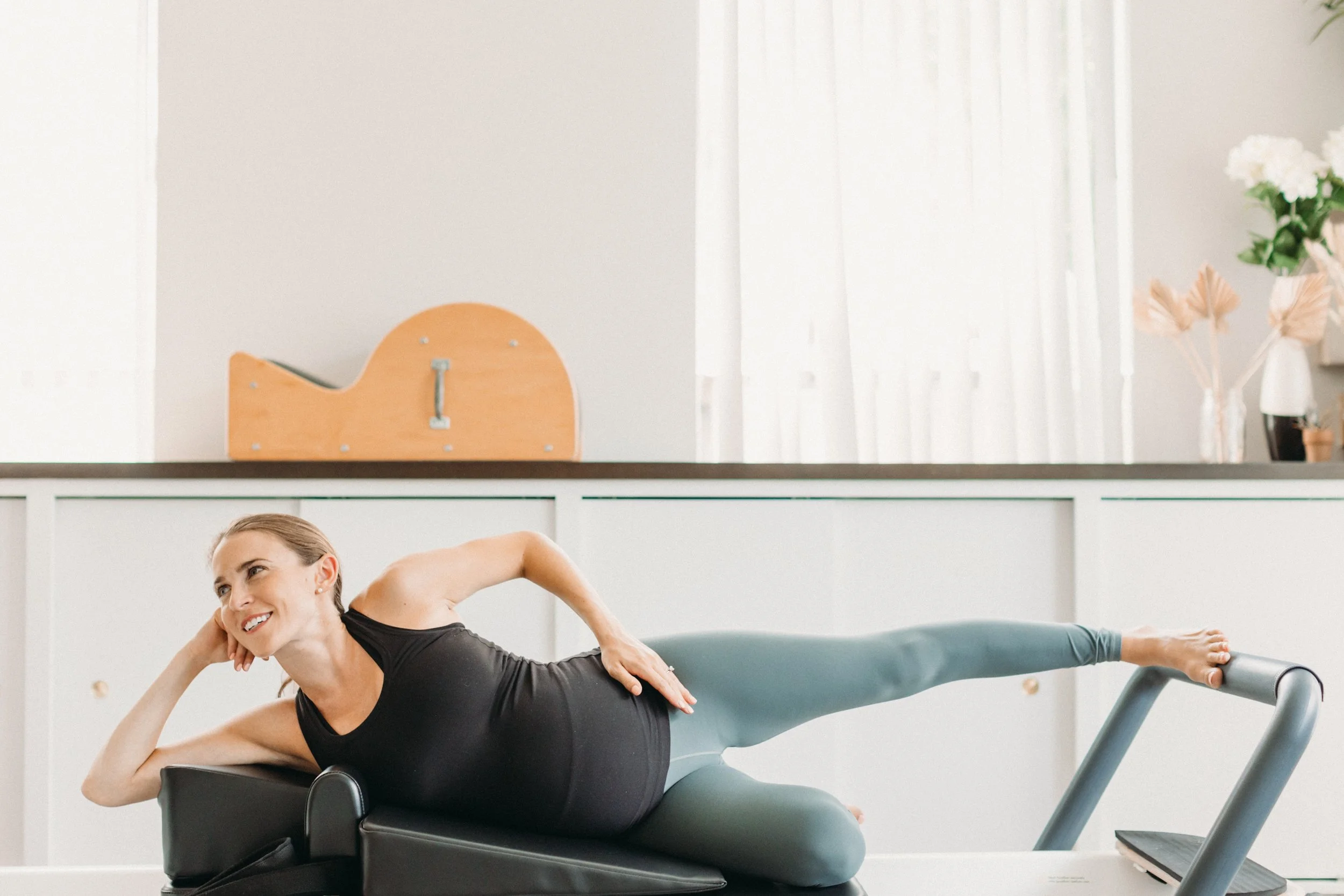
The Pilates Rx combines physical therapy, clinical Pilates, and personalized rehabilitation to rebuild core and pelvic floor coordination, improve pressure management, and restore strength. Our goal is to support you in moving confidently in everyday life and returning to the activities you love.
What is Diastasis Recti?
The two sides of your abdominal wall connect along the midline through a band of connective tissue called the linea alba. Diastasis recti, or diastasis recti abdominis (DRA), occurs when the linea alba stretches and thins, resulting in an increased separation between the two sides of the rectus abdominis.
During pregnancy, your uterus expands to accommodate your growing baby. The linea alba stretches to allow for this expansion. This is a normal physiological response to pregnancy, and not a sign that something has gone wrong.
Clinically, diastasis recti can be assessed by number of finger widths (>2), at, above, and below the umbilicus during a small abdominal curl. When testing we are looking at both the width of the separation as well as the depth and tension at the linea alba. Ultrasound is considered the gold standard for measuring inter rectus distance.
It's important to understand that diastasis recti is not simply about the number of finger widths between your abdominal muscles. The ability of the linea alba to generate and transfer tension, along with your overall abdominal wall function, matters just as much. And therefore the goal of rehabilitation is not just closing the gap but focusing on improving efficiency and overall function.
Can Certain Exercises Fix Diastasis Recti?
Social media is full of claims like "these exercises will fix your diastasis" or "never do crunches if you have diastasis recti." The reality is that there is no one size fits all exercise prescription. Rather than labeling exercises as universally good or bad, it’s important to understand that your exercise program should be individualized. We also want to stress you do not need to be afraid of movement. As you begin or progress your postpartum exercise routine, there are a few things worth paying attention to. These are not reasons to fear certain movements, but rather opportunities to better understand how your body is responding and modify accordingly.
Breath Holding or Bearing Down
Notice whether you are holding your breath or bearing down during an exercise. This may indicate difficulty managing pressure with the current demand. Try coordinating your exhale with the effort of the movement and adjusting the intensity as needed.
Coning or Doming Along the Midline
You may notice a visible bulge along the midline of your abdomen during certain movements. This is often referred to as coning or doming. Rather than assuming this movement is automatically harmful, use it as feedback. Pause, reconnect with your breath, and test whether a change in positioning, range of motion, or exercise intensity improves your ability to manage the movement.
Upper Abdominal Gripping
Instead of your core working as a coordinated system, we often see compensatory upper abdominal gripping. Notice whether you are excessively gripping through your upper abdominals, holding tension in your neck and shoulders, or struggling to breathe naturally during movement. It’s all about balance.
What Does Diastasis Recti Rehabilitation Actually Look Like At The Pilates Rx?
Rather than focusing solely on rebuilding your six pack muscles, it's important to understand that your deep core functions as a coordinated pressure management system.
Think of your core as a canister:
Top: Diaphragm
Bottom: Pelvic floor
Front and sides: Transverse abdominis and obliques
Back: Deep spinal stabilizers, multifidi
These muscles work together to manage intra-abdominal pressure, support your spine and pelvis, and coordinate movement.
At The Pilates Rx, we focus on reconnecting with and rebuilding this foundation. This includes developing awareness and coordination between your diaphragm, pelvic floor, and deep abdominal muscles.
1. Reconnect With Your Breath and Deep Core
We begin by focusing on breath coordination and the relationship between your diaphragm, pelvic floor, and deep core to manage intra-abdominal pressure and establish a foundation for more demanding activities.
2. Build Stability and Strength
From there, we progressively introduce stabilization and strengthening exercises. Our goal is to improve the ability of the abdominal wall to generate and transfer tension, support movement, and tolerate increasing demands.
3. Look Beyond the Abdominals
Postpartum recovery is about more than your abdominal muscles.Pregnancy involves nine months of significant physical changes and adaptations. Then comes postpartum life: feeding, carrying, lifting, bending, and caring for a newborn (and chasing after any older kids!). These repetitive demands can influence how you move and where you develop compensatory patterns.
That's why we take a whole body approach. Your breathing mechanics, neck and shoulders, rib cage, pelvis, and hips all contribute to how your body moves and manages load. A comprehensive rehabilitation program considers the entire movement system.
4. Integrate Pilates Principles into your Postpartum Rehabilitation
Pilates can be a valuable component of postpartum rehabilitation, particularly when integrated with an individualized physical therapy program. The Pilates Principles of: centering, concentration, control, precision, breath, and flow align well with the goals of diastasis recti rehabilitation. PT + Pilates = 🙌🏼
How The Pilates Rx For the Moms Program Supports Your Postpartum Recovery
At The Pilates Rx, our For the Moms program takes a comprehensive, individualized approach to postpartum rehabilitation.
We begin with an evaluation to establish your baseline and have objective information to work with. From there, we develop and progress an exercise program that layers breath coordination, pelvic floor and deep core connection, pressure management, stabilization, progressive strengthening, and therapeutic Pilates programming, while working towards your specific goals.
Our goal isn't simply to close the gap between your abdominal muscles. We want you to feel supported, strong, and capable in your everyday life, whether that means carrying your baby, lifting your toddler, returning to exercise, or getting back to the activities you love.
Learn more about FTM programming here and book a free discovery call with us today!
Reference
Du, Y., Huang, M., Wang, S., Yang, L., Lin, Y., Yu, W., Pan, Z., & Ye, Z. (2025). Diastasis recti abdominis: A comprehensive review. Hernia, 29, Article 222.
